

My Life in Upgrades: eMachines, AI, and the Art of Playing Bigger
How one questionable computer and a curious mindset changed everything.

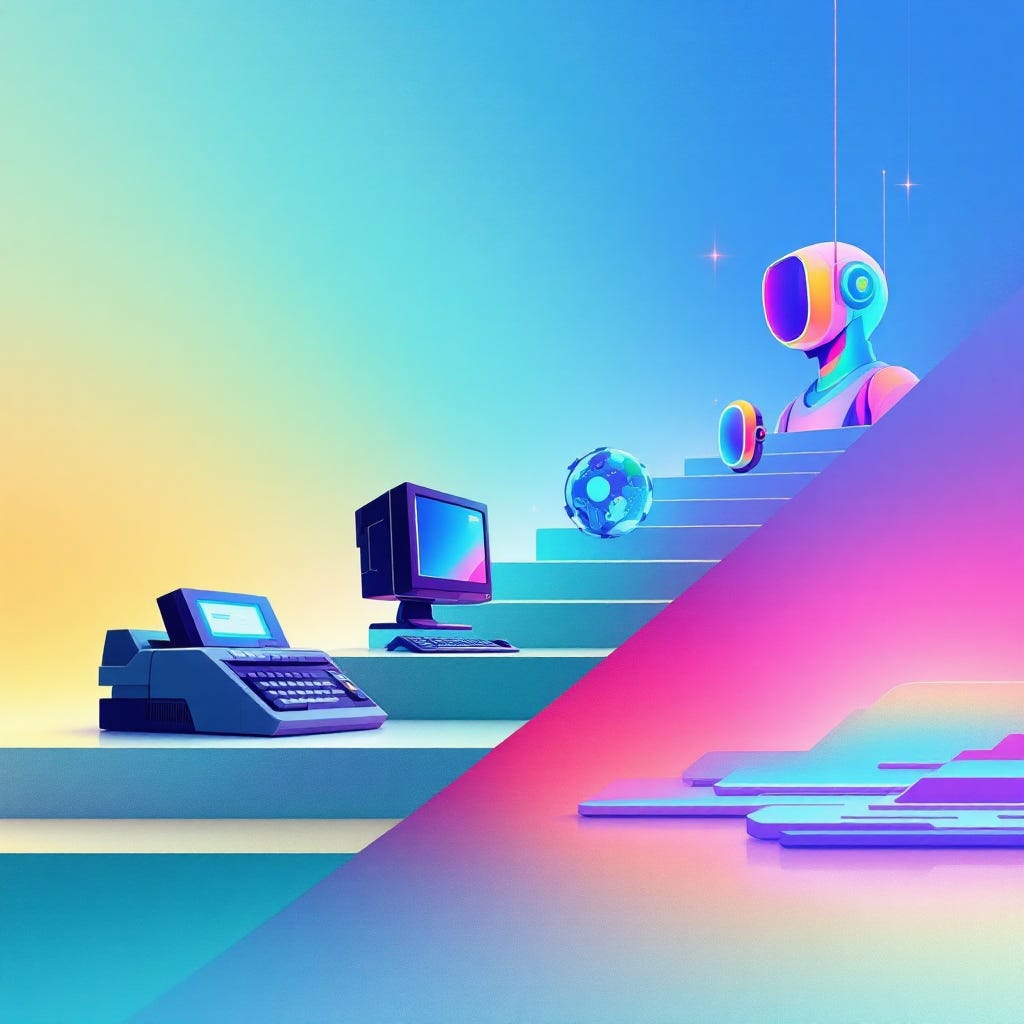
Around 2000, I upgraded my Brother word processor to an eMachine.
If you weren’t alive then (or were, but have blocked it out), the Brother let me type ideas and fix typos… sometimes. I think I could save files? Maybe? It was basically a typewriter with delusions of grandeur. But it worked. I wrote. I expressed myself. I was a writer.
Then came the eMachine — plus the free AOL CD from Target, Windows, Office Suite. Suddenly my creative universe expanded like it had eaten a whole star. I could save, sort, and organize files. I could research online.
I could read screenplays on my favorite site, Drew’s Script-o-Rama (still don’t know who Drew is — maybe he has an early founders support group with Craig and Angie.)
I downloaded Final Draft.
I wrote screenplays.
I became prolific.
Going from word processor to computer wasn’t a tool upgrade.
It was a category change.
Suddenly there were a dozen creative and career pathways instead of one. I went from “a person who writes” to “a person building a writing career.”
And, just like anyone discovering the internet in 2000, I also had to install my own guardrails so I didn’t accidentally lose twelve hours on Ask Jeeves.
That upgrade cracked my world open.
Until 2023 cracked it open again.
Then AI Came Along
I had learned about AI in 2020 on a book ghostwriting project, but I didn’t really process the implications. Then 2023 arrived and it felt like the universe dropped a new eMachine on my desk and said: “You’re up again.”
Then, my decades of ghostwriting, book coaching, content strategy, and, more recently, psychometric scale obsession, statistical nerdery, lil’ bit of R and SQL coding, and whatever part of my brain enjoys reading academic papers for fun… all converged.
Suddenly I could help authors and thought leaders build custom AI ghostwriters with cognitive and voice fidelity. Which, hilariously, is exactly what I’ve done for 24 years as a human.
Imagine that coincidence.
And this time the upgrade wasn’t from word processor to computer.
It was from computer to creative collaborator.
Let’s Connect the Dots
Going from the Brother to the eMachine made me a writer with range.
Going from computers to AI made me a writer with leverage.
One expanded what I could do.
The other expanded what I could be.
This analogy might sound like nonsense, because — let’s be honest —
the only controversial thing about an eMachine… was that it was an eMachine.
But the world doesn’t care whether your tools are controversial.
It cares what you build with them.
The eMachine opened the door to writing possibilities I didn’t know existed.
AI opened the door to career possibilities I didn’t know existed.
How to navigate Your Own AI Upgrade
Start with a single belief: It’s possible.
Then get curious about what “next level” might mean for you.
Back in 2000, I kept bumping my head on what I could accomplish with a word processor. I could feel there was something bigger just past the ceiling.
What are you bumping your head against right now?
Your talents, skills, and experiences — the ones you’ve been collecting for years — might be capable of something larger, something more spacious, something with more momentum than your current tools allow.
So yes, start with belief in possibilities.
But don’t stop there.
Ask yourself:
• What am I doing now that could become something more with more skill or better tools?
• What am I curious about but not yet good at?
• What would happen if I learned the missing pieces?
• Where am I waiting for permission instead of experimenting?
And for the love of all things agentic:
Stop basing your opinions on everyone else’s horror stories.
Build your own use cases (even if you don’t know what you’re doing).
Then decide.
Map it.
Spot the gaps — the “I don’t know how to do this” or “I don’t want to do this” zones.
Then instead of delegating, collaborate.
AI isn’t here to replace your work.
It’s here to extend it — like a second brain with fewer existential crises.
Curiosity over cynicism.
Playfulness over paranoia.
Possibility over panic.
You have enough information.
Enough prompts, enough thinkpieces, enough arguments to fill ten foxholes.
The question is no longer, “Is AI good or bad?”
It’s - “How can this make me more of myself?”
And try your best not to get lost in the hype, the pessimism, or the noise while you’re running your own experiments and figuring out what does and doesn’t work for you.
Because the next level — whatever it is — probably won’t arrive with fanfare.
It’ll arrive the way big shifts tend to…
Looking suspiciously like another eMachine box on your doorstep.